top of page
Historic Society Logo - PNG copy.png

Historic Society's
Virtual Museum 

The Coatesville Historic Society is pleased to provide you this online display of some of the artifacts we have collected to date. This collection and more can be seen Monday through Friday at Town Hall from 11:00 am to 3:00 pm. For those unable to see this in person, we are happy to provide you this online display. From time to time, we will add additional photos of future items we have collected as well as post other items we did not get in this round. For those that come to the area, but may not be familiar with Town Hall, it is located at 4994 Milton Street, Coatesville, IN 46121.  Click on the image for a larger view. Enjoy the collection.

1942 Drive-In Movie Paper

Circa: 1942

Item displayed or donated by: Mike Heimal, Auctioneer, Beech Grove

Drive-In Move at Harlan's Grove in Coatesville dated May 17th, 1942. Also advertising the roller skating every Thurs, Sat, and Sun night. This would have been located on south Milton where the old auction house resided almost across from the northwest corner of the cemetery.

Wellman's Gulf Service Car Broom

Circa: 1950s/1960s

Item displayed or donated by: Darrell Storm

A promotional item offered by Wellman's Gulf Service in Coatesville. Over the years this same station was known as a DX station and Cities Service Station.

Vandalia Railroad Signal Lock

Circa: 1920s

Item displayed or donated by: Steven Schultz

This is a brass Yale signal lock with cast lettering "VANDALIA RR SIGNAL". This one has a locking key. These railroad signal locks were used to secure railway signals and other equipment to prevent unauthorized changes. This helped to keep trains on the correct tracks and to avoid accidents.

Vandalia Railroad Lantern

Circa: 1890s - 1906

Item displayed or donated by: Steven Schultz

This Railroad Lantern was for the Vandalia Railroad which once ran through Coatesville. The glass is etched with the letters "VRR" indicating the Vandalia Railroad. Railroad lanterns with colored globes were used for signaling and illumination at night. The colors were similar to today's traffic lights, with white meaning safe to proceed, green meaning caution, and red meaning stop or danger. It's amazing that this lantern still has it's original etched glass. Many of these did not survive over time resulting in a glass replacement with no etching.

Herald Building Stone

Circa: 1948-1950

Item displayed or donated by: The Town of Coatesville

The herald building sat at the corner of Milton and Main Streets on the southwest corner. The address was 8023 Main Street and was used to produce "The Herald", a local paper published by Harmon Hathaway. He ran the "Hathaway Printery". Towards the top of the building was this embedded headstone that says "THE HERALD". Due to the building being deemed structurally unsafe, it was torn down on September 16th, 2015. The crew that took down the building was able to safely extract this stone from the structure without any damage. The Coatesville Herald produced their publication from 1910 until 1961.

Tom Underwood for Sheriff Button

Circa: 1990

Item displayed or donated by: Darrell Storm

Tom Underwood is a local resident of Coatesville. This campaign button was for Tom's Campaign run for Sheriff of Hendrick's County. Prior to running for Sheriff, Tom was an Indiana State Trooper for 25 years. After retiring as a State Trooper, Tom became the Chief Deputy of the Hendricks County Sheriff’s Department. After serving in that role for the next seven years, he decided to run for Sheriff of Hendrick's County. Tom won that election and served one term as the Sheriff from 1991-1994.

Coatesville Wall Phones Manufactured by S.E. Mark.

Circa: 1920s-1930s

Item displayed or donated by: Steven Schultz

These antique oak wall phones were manufactured by S.E. Mark of Coatesville. Each of his phones were built with a small brass name plate that reminded buyers of his name and town residence. We are not sure what the "E" stood for, but the "S" stood for Samuel, Samuel E Mark. He had a shop of three small rooms on the alley (now know as Hadley Street) just off Main Street. Samuel Mark was local "fix-it" man and his shop contained everything from watches, clocks, bicycles, and more. These phones were built by Samuel Mark in his shop. We are not sure how many he built, but a local restorer said his research indicated about 50 were made. That would make these phones rare to own one little more than two. We are lucky enough to have two of these phones. In the photo, the one on the left is a completely original unrestored S.E. Mark Wall Phone. The one on the right is a completely restored original S.E. Mark Wall Phone. Samuel was not only a "fix-it" man or builder of wall phones, he was also an inventor. He filed for a patent on October 21st, 1909 for a "Lightening Arrestor" attachment for resident phone lines allowing current to pass normally (reference Patent # 1,004,826 / Serial # 523761). These types of wall phones made usually in oak were nice looking piece and are sought after by collectors today. The conversation range on these phones were a remarkable 15-18 miles. That was very remarkable for this period of time more than 100 years ago. Of course today we can talk to people in outer space, but it was the small steps of these early phones that lead us to where we are today. If you think about that and how far we have come in one century, it really is amazing!

R.G. Walters For Trustee Matchbook

Circa: 1974

Item displayed or donated by: Darrell Storm

This Matchbook was a campaign piece for local Coatesville resident Ronald G. Walters from 1974. It is dated November 5, 1974 urging folks to vote for R.G. Walters, a democrat running for the office of Trustee of Clay Township.

Powell Funeral Home and Furniture Store Lock Box

Circa: Est 1940s-1950s

Item displayed or donated by: Steven Schultz

This metal lock box with keys measures about one foot long. This box is marked as "Powell Funeral Home and Furniture Store". Powell did own both at the same time, so although we do not know how it was used, we can surmise it was used for petty cash in the store, the transporting of deposits to the bank, or for some other reason unknown to us.

Powell Funeral Home Hand Fan

Circa: 1940s

Item displayed or donated by: Darrell Storm

Advertising hand fans joined art with an impulse to make money in an outpouring of promotional gimmicks that peaked at the turn of the century that remained popular until the 1940s. The hand fan shown here was a promotional fan for Powell Funeral Home specifically noting their "prompt ambulance service". The advertising portion was on the back of the hand fan with the art on the front as shown in the image.

Ira Masten Chevrolet Service Hand Fan Promotional Item

Circa: 1940s

Item displayed or donated by: Darrell Storm

Promotional hand fans were popular in the 1940s, even though hand fans as a fashion accessory were declining. They were a popular advertising tool especially for businesses and politicians. They were mass-produced and inexpensive, and were used to advertise almost every brand. The popularity of promotional fans peaked at the turn of the century and remained popular into the 1940s. The popularity of church fans was also high in the first half of the 1900s because air conditioning was expensive for many institutions. This particular hand fan was an advertising piece for Ira Masten's Chevrolet Dealership, specifically for automotive service. Ira Masten was a local businessman and owned the dealership. It was a small dealership located on Milton Street on the north side of the gas station at Milton and Main Streets. The building has been gone for some time and all that remains is a vacated space where it once stood. The larger image of the photo is the advertising piece and in the lower left you will see the other side of the fan with a decorative image. It is unclear on this one how they came about with this particular image or what it was meant to represent if anything.

Coatesville First National Bank Promotional Liberty Bell

Circa: 1919-1921

Item displayed or donated by: Darrell Storm

This is a nice vintage Liberty Bell promotional piece. The bank is metal with a wooden yoke. This was originally offered as a customer promotion for banks across the country. This particular bank was offered by the First National Bank of Coatesville, Indiana. These metal banks measured 4" tall and 3.5" wide at the base. The plate on these Coatesville First National Bank Liberty Bells state "RING IT AGAIN" on line one, "FIRST NATIONAL BANK" on line 2, and "COATESVILLE, IND." on line three.

Handmade Farm Supply Company Sign

Circa: 1950s

Item displayed or donated by: N/A

This is a handmade Farm Supply Company sign. We don't know the origins of this sign or how it was used, but it was made for the Coatesville Farm Supply Company.

International Trucks - Farm Supply Co. Ruler

Circa: Late 1940s

Item displayed or donated by: Darrell Storm
This is a 1940's International Trucks and Farm Supply Company ruler from Coatesville. This is a metal advertising ruler with an old 3 digit phone exchange on it. The Triple Diamond logo was introduced with the K-series trucks in the late 1940s.

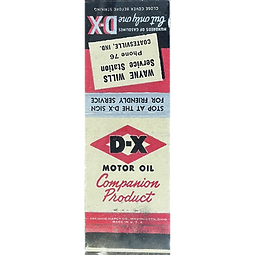
DX Gas - Wayne Wills Service Station Matchbook Cover

Circa: 1930s to 1940s

Item displayed or donated by: Steven Schultz

This matchbook is cover is from Wayne Wills Service Station. It stood at Main Street and Milton Streets on the northeast corner. From what we can tell, this was originally built as a DX station and switched owners and companies over the years. We believe this dates back as early as the 1930s or 40s. The building still stands today, although we are sure it has changed over time (the is no known photo of the station from that era). Today it has been transformed into a 1950's Standard Station as it was in the 50s, but it is not a functional service station.

Collection of Coatesville Yard Sticks

Circa: Unknown/Various

Item displayed or donated by: Darrell Storm

This is a collection of Coatesville yardsticks. These are all from various businesses over the years and at different periods of time. What you see are the following: Yellow Yard Stick: Business name is "Country L.P. Gas" at U.S. Junction 40 and State Road 75. This is the most recent one of this collection. Brown Yard Stick (below the yellow one): Business name is "Coatsville Farm Supply, Inc." Based on the early telephone exchange of B-67, we would place this one to be from the 1940s. You will see a constant theme on many items from 60 years or more with Coatesville spelled without the "e". Red Yard Stick: Business name is "Collier Lumber Company" advertising "Complete Construction and Remodeling Service". Again with the early phone exchange of B-29, we estimate this to also be 1940s. The fourth and final yard stick is from the business "R&D Landscaping on RR#1.

Coatesville Train Depot Brick

Circa: Est to be late 1800s

Item displayed or donated by: N/A

It is not clear on when the train depot was built, but it was torn down sometime in the 1980s. The train used to carry passengers on the line which today is called the Vandalia Trail. The original tracks ran right through Coatesville where the trail is today and some remnants of it can still be seen west of town. As for the depot, as we understand the story, the building was torn down and a local resident was hired to haul away the debris and brick. The resident took the brick to his home or near his home and used it to block or divert a creek. Year's later we had someone go looking for remnants of the old building, but all had been swept away and/or is settled and buried somewhere deep in the ground. However, with one exception, this one and only authentic brink from the depot was found on the site pretty well intact. It is now referred to as the last brick remaining from the original train depot.

Generic Coatesville Postcard

Circa: 1900-1910

Item displayed or donated by: Steven Schultz

This Vintage Postcard has no date stamp and does not appear to have been mailed even though the back is filled out. The back of the card is very hard to read, but after considerable review we have determined is says the following: "Well Frances, Bethel has Emily and they are having a good time. Bethel sent her mama a birth day card. I want to know if she got it or not. Was so glad you got promoted. Bethel and Grandma".

Vintage Coatesville Photograph Postcard

Circa: 1910

Item displayed or donated by: Steven Schultz

This is a very rare Coatesville Photograph Postcard from 1910. It is postmarked September 16th, 1910 with a one cent stamp. This photo postcard includes photos from around town more than 110 years ago and has survived time to find its way into our hands. Images from around town include: 1) Street Scene on Broadway Street 2) Interurban Station 3) a view looking west down Main Street from Milton Street 4) Coatesville United Methodist Church (Coatesville's first church) 5) Coatesville Christian Church 6) School House once located where the ball fields reside today.

Coatesville Elevator Thermometer

Circa: 1950s/1960s

Item displayed or donated by: Darrell Storm

This Coatesville Elevator Thermometer was possibly a promotional item. It was designed to mount to a wall.

First National Bank Pewter Ashtray

Circa: Est 1980's

Item displayed or donated by: Darrell Storm

This pewter ashtray shows an engraving of the Coatesville First National Bank building as it sits now at 4122 State Road 75. Also engraved into the pewter ashtray below the bank's image are the words "The Coatesville National Bank" in cursive. Below that is says "Of Coatesville" in the same engraved script. followed by the words "COATESVILLE ELEVATOR" below the image. Below that in cursive writing it says "Our 50th Anniversary" followed on the next line with "1927-1977". The fourth and final line in cursive writing says "Serving Agriculture for Four Generations". The third line says " SAFE - STRONG - DEPENDABLE". Below that under SAFE it sys 1908 and below DEPENDABLE it says 1980 which would represent the years.

Coatesville Elevator Pewter Ashtray

Circa: Late 1970s

Item displayed or donated by: Darrell Storm

This pewter ashtray represents the 50th Anniversary of the Coatesville Elevator. An image of the elevator is engraved into the pewter ashtray followed by the words "COATESVILLE ELEVATOR" below the image. Below that in cursive writing it says "Our 50th Anniversary" followed on the next line with "1927-1977". The fourth and final line in cursive writing says "Serving Agriculture for Four Generations".

Coatesville Elevator Advertising Piece

Circa: Est 1970s

Item displayed or donated by: Darrell Storm

This Coatesville Elevator item was a promotional piece to help advertise their business. This piece is a compact mirror in a plastic case. It came in various colors and states "Serving Agriculture for four generations. It is not know how these were given out.

1902 Blue Seal Coatesville National Bank $10 Note

Circa: 1902

Item displayed or donated by: Steven Schultz

In 1902, the National Bank began the issuance of these $10.00 bank notes. The whole ideas was to provide a stable and widely accepted form of currency during a time when different banks issued their own notes with varying value. Banks with a federal charter would deposit government bonds with the Treasury, allowing them to print notes up to a certain percentage of the bond value. The issuance of National Bank Notes ceased in 1935 as the government retired the bonds used as collateral. What you see pictured here is a 1902 Blue Seal Coatesville National Bank Note. A red and blue seal version of this note were produced by various charters. The Coatesville National Bank was assigned Charter Number 8447. A "1902 Blue Seal National Bank Note" differs from a "1902 Red Seal National Bank Note" primarily by the color of the seal on the front of the note, with the blue seal note being considered a later issue that replaced the red seal notes. This signified a change in the issuing bank's charter period. Both are types of National Bank Notes issued around 1902, with the "red seal" generally being considered more valuable due to its rarity compared to the "red seal" version. Printed from 1902 to 1908, Red Seal National Bank Notes are scarce in any condition. With the bulk of known survivors representing the $5, $10, and $20 denominations, $50s and $100s are virtually unseen outside of the most advanced collections.

1929 Type 1 Coatesville National Bank $10 Note

Circa: 1929 - 1933

Item displayed or donated by: Steven Schultz

In 1929, the First National Bank, along with other national banks, issued "charter notes" (also known as National Bank Notes) because it was part of a system established by the federal government where banks with a federal charter could print their own currency, backed by government bonds they deposited with the Treasury, effectively allowing them to contribute to the nation's money supply while maintaining a standardized currency across the country; this practice ended in 1935 with the retirement of the bonds used for security. 1929 Type 1 and Type 2 bank notes were small-size National Bank Notes issued in the United States. They were issued to replace larger bills that were more expensive to produce. Type 1 notes were issued from June 1929 to May 1933 and is the most common of the two notes. Type 2 notes were issued from May 1933 to 1935 and are less common. These notes are scarce because the Great Depression hit shortly after they were released and the banking system was reorganized. It is said that the First National Bank of Coatesville printed $423,790 worth of National Currency. The Coatesville First National Bank was assigned Charter Number 8447.

Cities Service - Glen Curtis Vintage Matchbook

Circa: 1950's

Item displayed or donated by: Darrell Storm

Glen Curtis once owned the service station on the northwest corner of Main Street and Milton Street. The station was a Cities Services station in the 1950's. This is a promotional matchbook cover from that store at the time Glen owned it. It also advertised that he did general trucking and notice the spelling for Coatesville which was somewhat common around this and earlier eras.

Coatesville Cast Iron Seal Press & Pens

Circa: 1900-1920

Item displayed or donated by: The Town of Coatesville

This cast iron seal press was used by the early Coatesville Town Clerk. It was primarily used by the Town Clerk to press the a town seal into a gold foil for official documents and/or mailing purposes. The fountain pens are actual pens that were used by the Town Clerk more than 100 years ago. They were used to write and document town meeting minutes including other official town related documents.

Hand Shovel Advertising Piece

Circa: Est 1970s

Item displayed or donated by: Darrell Storm

This yellow plastic hand shovel was an advertising piece handed out by Brown's Store. The shovel is stamped "BROWN'S STORE" followed by "Coatsville, Indiana" on the second line an "Phone 386-7225" on the third line. We are not familiar with the store location where this item might have come from. You will notice that Coatesville is spelled differently on the shovel without the "e". We wouldn't call that a misspelling as many businesses back in the early to mid 1900's would spell Coatesville as Coatsville.

1913 Indiana License Plate

Circa: 1913

Item displayed or donated by: Steven Schultz

Indiana's first license plates were issued in 1913 and were made of porcelain on a heavy metal base. They were a generous 4.5 in x 14.5 in and had a black serial number on a yellow background. The plates also had "IND 1913" in yellow on a black section on the right. The plates were made by the Quayle Enamel Company and the Secretary of State's office in Indianapolis distributed the plates. Around 45,000 plates were issued in 1913. The plate pictured here was not necessarily from Coatesville, but it is an authentic plate from 1913. This plate serves as a real example of what you would see on vehicles in Coatesville and throughout the State of Indiana in 1913.

© Copyright 2025 Town of Coatesville, Indiana.

All rights reserved.

COATESVILLE TOWN HALL

4994 Milton Street  /  PO Box 143

Coatesville, IN 46121

765-386-7205

Open 11:00 am to 3:00 pm Monday-Friday.
Closed Saturday, Sunday, and  on Major Holidays

bottom of page